

Caregiving often becomes overwhelming, one small task at a time. Laundry waits, meals become rushed, the house gets harder to manage, and the person providing care has less room to sleep, work, or simply think. The problem is not always that a family needs a completely different care plan. Sometimes it needs practical help with the work surrounding care. This article explains how household support can reduce pressure, which tasks to hand off first, and how to choose help that fits the family.
TL;DR
– Start by listing the household jobs that keep care from fitting into the day.
– Hand off recurring tasks before asking a family caregiver to give up more personal time.
– Build household help around the hardest parts of the day, not around everyone else’s convenience.
– Keep personal care decisions separate from chores, so each person knows their responsibility.
– Treat caregiver burnout support as a plan for sharing work, not a test of family commitment.
Household Help Changes the Work Around Care
Household help for family caregivers is not simply someone doing chores. It is a way to remove the work that builds up around meals, mobility, appointments, medication routines, and daily living.
A family caregiver may be able to help a parent get ready for the day but struggle to keep up with grocery shopping, meal preparation, laundry, dishes, and a safe path through the home. Those unfinished jobs can make every care task feel harder. The caregiver is not only helping a relative; they are also trying to run two households, manage their own job, or coordinate siblings who live elsewhere.
The useful question is not, “Can the family keep doing this alone?” It is, “Which work is making the care arrangement harder than it needs to be?” A relative may want to continue helping with conversation, rides, or familiar routines while someone else handles meal preparation or light housekeeping.
That distinction matters. Household help does not replace family involvement. It can protect the time family members still want to spend together by taking routine work out of the middle of it.
Identify the Tasks That Drain the Day First
Start with the tasks that repeat often and leave the caregiver with the least flexibility. Those are usually the first jobs worth sharing.
A long task is not always the hardest task. A short job that must happen every morning, every evening, or after every meal can create more strain than a larger task done once a week. For example, a caregiver may manage a weekly grocery trip but feel stretched by daily cooking, dishwashing, trash removal, and tidying before bedtime.
Write down a normal week without trying to solve it yet. Include care tasks, household work, travel, phone calls, work obligations, and time that disappears because something unexpected needs attention. The goal is to see where the day becomes crowded.
A practical list may include:
1. Preparing meals and cleaning up afterward
2. Keeping laundry moving and put away
3. Shopping for groceries and household supplies
4. Organizing the home before a visit or appointment
5. Handling light housekeeping that affects daily comfort
The list should reflect the family’s real routine, not an ideal one. If evenings are difficult, support may be more useful then than during a quiet part of the afternoon.
A skipped task can become a warning sign
A skipped household task does not mean a caregiver has failed. It may show that the current arrangement leaves no margin for an ordinary day.
Look for work that is repeatedly postponed, rushed, or completed after the caregiver should be resting. That pattern can help a family decide where support belongs. A person may still want to handle a parent’s favorite meal once a week, for instance, while arranging help with the meals that happen on busy weekdays.
Separate Household Work From Personal Care Decisions
Families need clearer roles before they need a larger schedule. When everyone assumes someone else is handling a task, the caregiver usually fills the gap.
Household work and personal care can overlap, but they are not the same responsibility. Household help may cover meal preparation, tidying, laundry, and errands. Personal care may involve help with bathing, dressing, toileting, or moving safely around the home. Skilled nursing services involve a different level of care and should be discussed with the person’s nurse or doctor when medical judgment is needed.
Separating these jobs makes planning easier. It also helps the older adult understand what kind of help is being proposed. A parent who resists “care” may be more open to someone helping with laundry or preparing a few meals. That does not solve every concern, but it can make the first conversation less loaded.
Set responsibilities in plain language. Avoid vague promises such as “I’ll help more.” Instead, name the task, the day, and the person responsible. If a sibling handles grocery orders and another family member visits on Sundays, the primary caregiver can see what support is actually dependable.
Keep medical questions with the right professional
Household support should not be used to guess at a medical need. If a family is unsure whether someone needs skilled nursing, medication support, or a change in care after a hospital stay, the person’s doctor, nurse, or pharmacist should guide that decision.
That conversation can run alongside household planning. One addresses health needs; the other makes daily life more workable.
Build Help Around the Toughest Hours
The schedule should cover the moments that create the most pressure, not just the times someone happens to be available. A plan built around convenience can leave the caregiver alone during the part of the day that matters most.
For some families, mornings are difficult because getting dressed, preparing breakfast, and leaving for appointments all happen at once. For others, evenings bring meal cleanup, fatigue, and worries about whether the home is ready for the next day. The family does not need to label either period as a crisis to recognize that it needs support.
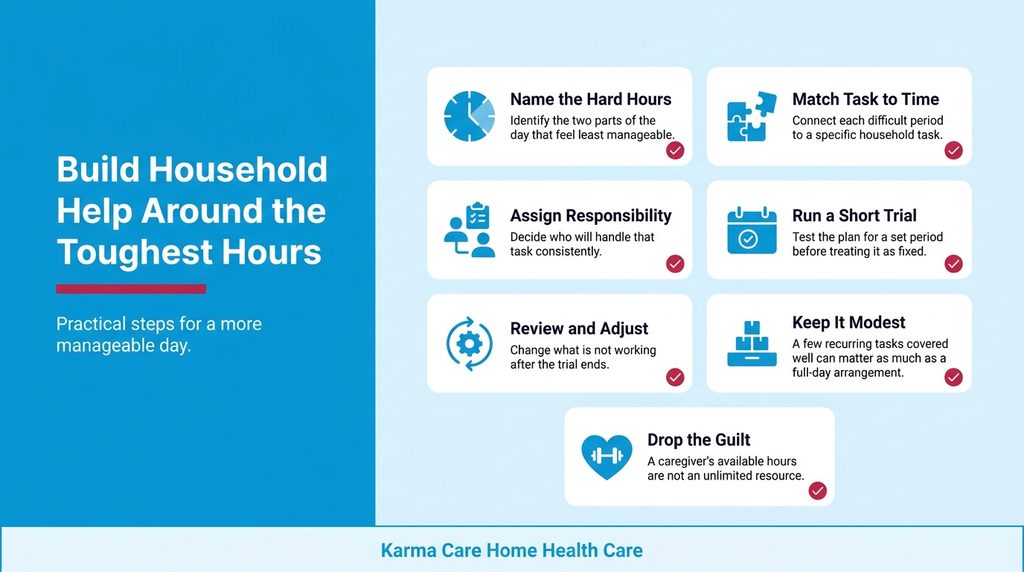
Use this sequence to build a workable arrangement:
1. Name the two parts of the day that feel least manageable
2. Match each difficult period to a specific household task
3. Decide who will handle that task consistently
4. Review the plan after a short trial and adjust what is not working
A schedule can be modest and still matter. Household help for family caregivers may mean assistance with a few recurring tasks rather than a full-day arrangement. The right amount depends on what the older adult needs, what family members can realistically do, and which responsibilities are being missed.
Do not build the schedule around guilt. A caregiver’s available hours are not an unlimited resource.
Talk About Help Without Turning It Into a Family Argument
Keep the conversation focused on specific daily problems rather than telling someone they can no longer cope.
Instead of saying, “You need help,” talk about what is becoming difficult, such as meals on workdays, laundry, shopping, or evening cleanup. Ask which tasks the older adult wants to keep doing and which ones they would be comfortable sharing.
Family members should also be clear about their own limits. A spouse or adult child can stay involved without being responsible for every task.
Caregiver burnout support works better when the plan respects both the older adult’s preferences and the caregiver’s realistic capacity.
Family Care, Household Help, and Broader Support Compared
The right choice depends on the work that needs to be shared and the level of help the person needs at home.
| Option | Works When | Breaks When | Trade-Off |
| Family-only care | Tasks remain manageable | One person carries everything | Less personal time |
| Household help | Chores create daily pressure | Personal care needs increase | Requires coordination |
| Personal care support | Daily living needs assistance | Medical needs remain unclear | More scheduled visits |
| Skilled nursing services | Clinical care is ordered | Household tasks stay uncovered | Different care purpose |
Family-only care can work when responsibilities are shared clearly and the schedule still leaves room for the caregiver’s own life. It becomes harder when one person becomes the default for every meal, errand, cleanup, and appointment.
Household help can remove routine work that crowds out rest and family time. Personal care may be the better discussion when the person needs help with daily living tasks. If the family is unsure which kind of support fits, begin by describing the actual tasks and asking the appropriate care professional what level of care is suitable.
Where This Approach Does Not Apply
Household support is not enough when the main concern is medical, behavioral, or immediate safety. Changes such as falls, confusion, medication problems, or new difficulty with daily activities should be discussed with the appropriate healthcare professional.
It may also be the wrong starting point when family responsibilities are still unclear. Adding more help to an unorganized plan can create more confusion.
If an older adult does not want assistance and can make that decision, keep the conversation open and revisit the plan if needs change.
Final Verdict
If household tasks are taking more energy than the care itself, start there. Caregiver burnout support can mean removing the repeating work that leaves a spouse or adult child with no time to recover. If one or two tasks are the problem, share those first. If help with washing, dressing, eating, or moving safely is also needed, describe those needs clearly when discussing a care plan. Household help for family caregivers works when it is specific, regular, and built around the hours that are hardest to cover. If your family is unsure what kind of support fits, write down a typical week before making the next decision.
FAQs
Q: What household tasks should a family caregiver hand off first?
A: Start with tasks that repeat often and are most likely to be skipped when the day gets busy. Meals, laundry, grocery shopping, dishes, and light housekeeping are common examples. The right first task is the one that creates the most pressure or takes time away from essential care and rest.
Q: Is household help the same as personal care?
A: No. Household help usually focuses on tasks such as meals, laundry, errands, and tidying. Personal care involves help with daily living activities, such as bathing or dressing. Families should describe the help needed clearly so they can discuss the right type of support rather than treating every need as the same.
Q: How do I ask my parent to accept help at home?
A: Begin with a specific daily problem instead of a broad statement that they need care. Ask what tasks they would most like to keep doing and which ones feel less important. Offering help with chores or meals may feel more acceptable than framing the conversation as a loss of independence.
Q: When should a family ask about skilled nursing services?
A: Ask the person’s doctor or nurse when the family has questions that depend on medical judgment, especially after a health change or hospital stay. Household help may still be useful, but it should not be used to decide whether clinical support is needed. The care team can help clarify the appropriate next step.
